
Is Ovarian Reserve Really Fixed? What AMH, FSH, and Inhibin B Can and Cannot Tell Us
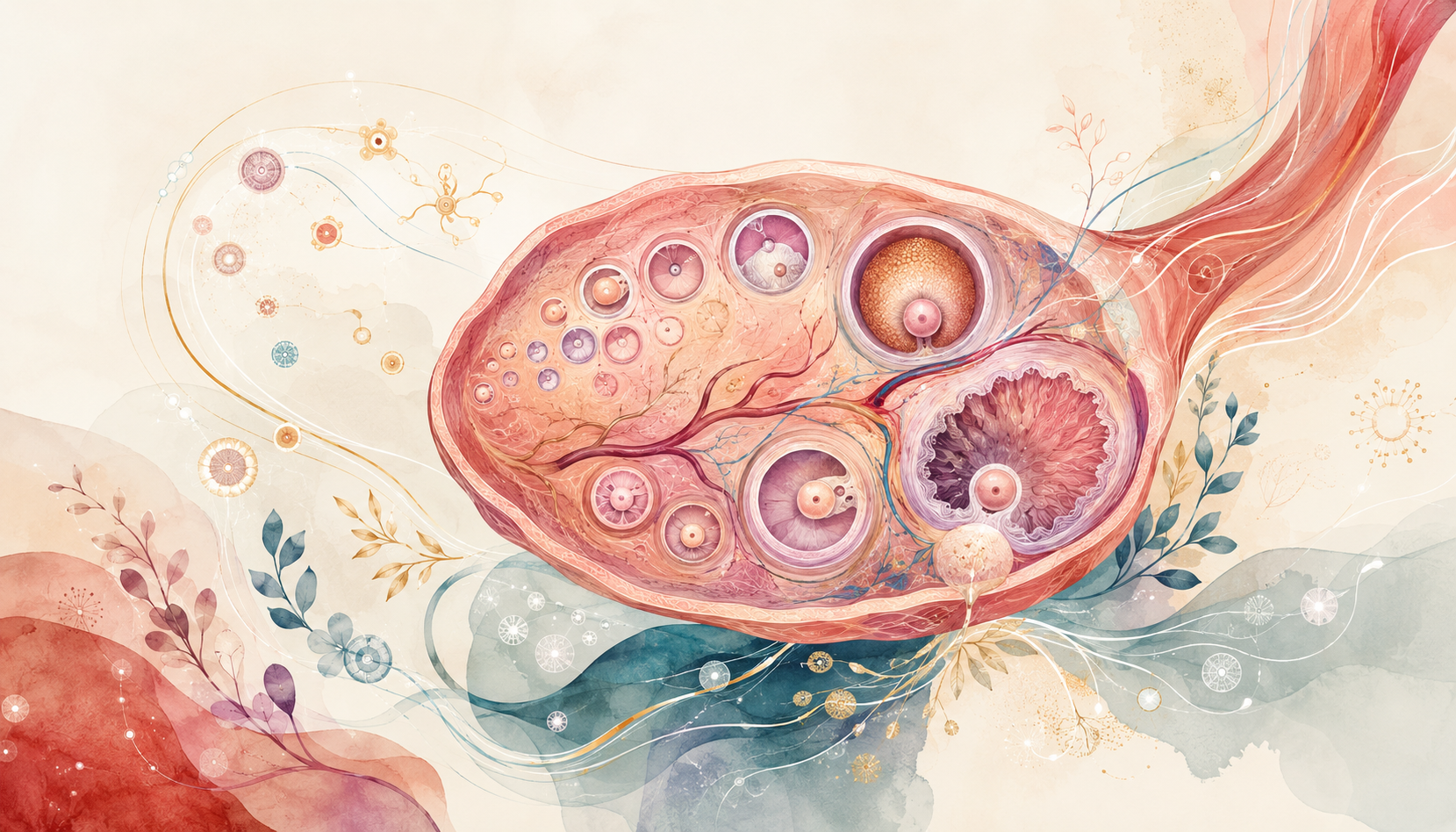
The ovary is more dynamic than the old “biological clock” story suggests. A low ovarian-reserve marker is important information, but it is not a fertility verdict-and an improved marker does not necessarily mean that new eggs were created.
By Dr. Rosia Parrish, ND
For decades, women have been taught to picture ovarian reserve as a bank account with a fixed number of eggs and only withdrawals. In that model, every month brings an irreversible loss, a low anti-Müllerian hormone (AMH) result means the account is nearly empty, and very little can change the trajectory.
There is truth in part of that model: the best-supported human evidence still indicates that women are born with a finite pool of primordial follicles that declines with age. We do not currently have convincing evidence that healthy adult ovaries routinely manufacture clinically meaningful numbers of brand-new eggs.
But the “fixed bank account” analogy is also incomplete.
The ovary is a living, hormonally responsive organ. Follicles move through different developmental stages over many months. The ovarian environment communicates continuously with the brain, thyroid, adrenal and metabolic systems. Hormonal contraception, pregnancy and the postpartum period, PCOS, ovarian surgery, endometriosis, smoking, chemotherapy, body composition, nutrient status, medications and even the laboratory method used can affect the numbers we see.
That means ovarian-reserve markers are more fluid than many women have been led to believe, and ovarian function can sometimes recover or reactivate after suppression or injury. The regenerative biology of ovarian tissue is also an exciting area of research. The key is to distinguish three very different ideas:
A biomarker can improve.
Existing follicles can resume growth or become more hormonally active.
Entirely new eggs can be created.
The first two clearly occur. The third remains unproven in routine human biology.
Ovarian reserve is not the same as fertility
Ovarian reserve refers primarily to egg quantity, not egg quality and not the chance of conceiving in any single month. Age remains much more strongly associated with egg quality and embryo chromosomal competence than AMH does.
This distinction matters. AMH and antral follicle count (AFC) are useful for estimating how the ovaries may respond to fertility medications and approximately how many eggs might be retrieved during an IVF cycle. They are much less accurate as stand-alone predictors of spontaneous conception or live birth.
The American Society for Reproductive Medicine (ASRM) emphasizes that ovarian-reserve markers predict egg yield better than reproductive potential and should not be used to deny fertility treatment. In a prospective cohort of women ages 30 to 44 without known infertility, low AMH or elevated FSH did not significantly reduce the probability of conception over six or 12 cycles. More recent research has suggested that very low AMH may be associated with a modest reduction in natural fecundability, but the message remains the same: AMH is not a pregnancy test, an egg-quality test or an expiration date.
What the major ovarian-reserve markers actually measure
AMH: a signal from the growing follicle cohort
AMH is made primarily by granulosa cells surrounding primary, preantral and small antral follicles. It is often described as a measure of “how many eggs are left,” but that is an oversimplification. A blood AMH result reflects the hormonally active, growing follicle population that is producing AMH at that moment. It does not directly count every dormant primordial follicle in the ovary.
AMH is generally more stable across the menstrual cycle than FSH, which is why it can usually be measured on any cycle day. “More stable,” however, does not mean fixed. AMH can vary within and between cycles, between laboratories and assays, and in response to hormonal suppression or changes in follicular activity.
A striking example is hormonal contraception. In one prospective study, AMH increased by an average of 53% and AFC by 41% after women discontinued long-term combined oral contraceptives, with values returning to a plateau within approximately two months. Those women did not suddenly create 53% more primordial follicles. Rather, suppression was lifted and the measurable growing-follicle cohort became more visible.
AMH may also be:
Higher in PCOS because more small follicles are producing AMH. A high AMH is therefore not automatically synonymous with better fertility.
Temporarily altered during pregnancy and the postpartum period.
Lower during hormonal contraceptive use.
Reduced after ovarian surgery, especially procedures involving ovarian tissue or endometriomas.
Reduced by gonadotoxic chemotherapy or pelvic radiation, with partial recovery possible in some women depending on age, pretreatment reserve and treatment type.
Influenced by assay differences, sample handling and individual biology.
FSH: the brain’s request for more ovarian response
Follicle-stimulating hormone (FSH) is produced by the pituitary gland. When the growing follicle cohort produces less inhibin B and estradiol, the brain receives less negative feedback and may release more FSH to stimulate the ovaries.
FSH is best interpreted early in the follicular phase, usually on cycle day 2, 3 or 4, and it should be read alongside estradiol. A higher FSH can be a fairly specific sign of diminished ovarian reserve, but it is not very sensitive and can fluctuate substantially from one cycle to another.
Estradiol is especially important because an early estradiol rise can suppress FSH into a deceptively “normal” range. A normal FSH with an elevated day-3 estradiol is not interpreted the same way as a normal FSH with an appropriately low early-follicular estradiol.
One isolated FSH value, high or low, should never be treated as the whole story.
Inhibin B: useful physiology, limited stand-alone testing
Inhibin B is produced by developing ovarian follicles and helps suppress pituitary FSH. As the responsive follicle cohort becomes smaller, inhibin B may fall and FSH may rise.
Although this relationship is physiologically meaningful, inhibin B has substantial biological and laboratory variability. It has not performed as well as AMH or AFC in routine ovarian-reserve assessment, and ASRM does not recommend it as a stand-alone ovarian-reserve test. It may still add context in select clinical situations, especially when interpreted as part of a broader hormonal pattern rather than as a single pass/fail number.
AFC: the ultrasound view
Antral follicle count measures the small follicles, typically 2 to 10 millimeters, visible on an early-follicular-phase ultrasound. AFC and AMH often agree, but they can be discordant. Scan timing, equipment and the experience of the sonographer matter. ASRM notes that AMH and AFC may disagree in up to roughly 30% of cases, which is another reason not to let one result define a woman’s reproductive future.
So, is the ovary regenerative?
The answer depends on what we mean by regenerative.
Yes: ovarian function has more capacity for recovery than a single test may suggest
Existing follicles can move from dormant to growing stages. Granulosa cells can change how much hormone they produce. The hypothalamic-pituitary-ovarian axis can recover after suppression. AMH and AFC can rebound after hormonal contraception is discontinued. In some patients treated for cancer, AMH rises for months or even years after chemotherapy as surviving follicles resume activity. Women with nonsurgical premature ovarian insufficiency can also have intermittent ovarian activity and occasional natural conception.
These are genuine examples of resilience and functional recovery. They remind us that an ovary is not a static container and that one low result may capture a suppressed or temporarily altered moment.
Not yet proven: routine creation of new human eggs
Researchers have investigated putative oogonial stem cells, ovarian organoids, mitochondrial therapies, in-vitro activation of dormant follicles, stem-cell treatments, platelet-rich plasma (PRP), and signaling pathways such as Hippo and PI3K-AKT-mTOR. These fields are scientifically fascinating, and some laboratory and early clinical observations suggest that ovarian tissue may have greater reparative or reactivation potential than previously appreciated.
However, the existence and reproductive significance of egg-producing stem cells in adult human ovaries remain controversial. Current evidence does not show that a supplement, diet or office procedure can reliably rebuild a depleted primordial-follicle pool. Ovarian PRP and stem-cell therapy remain experimental; European Society of Human Reproduction and Embryology guidance does not recommend them for routine care because controlled efficacy and long-term safety data are insufficient. Two randomized PRP trials published in 2024 did not demonstrate better pregnancy rates or embryo euploidy, and true ovarian “rejuvenation” remains unproven.
“Reactivation” or “functional recovery” is therefore more scientifically accurate than “making new eggs.”
What can help support ovarian health and the remaining follicle cohort?
No responsible clinician can promise to raise AMH or restore egg number. There is still a great deal we can do to protect ovarian health, identify reversible suppression and support the function of the follicles that remain.
1. Interpret the data correctly before trying to change it
A thoughtful evaluation may include age, menstrual and ovulatory history, medication and contraceptive use, AMH, day-2-to-4 FSH and estradiol, AFC, prior ovarian surgery, endometriosis, family history of early menopause or POI, autoimmune history, genetic risks, chemotherapy or radiation exposure, and the male partner’s fertility factors.
When a result does not fit the clinical picture, repeating it under comparable conditions and at the same laboratory may be more informative than immediately adding a treatment. After discontinuing combined hormonal contraception, it may take approximately two to three months for AMH and AFC to better reflect the unsuppressed baseline.
2. Protect the reserve that remains
The most evidence-aligned “ovarian reserve support” is prevention of avoidable harm:
Avoid cigarettes and nicotine exposure, which are associated with earlier ovarian aging and increased POI risk.
Discuss the ovarian impact of endometrioma or other ovarian surgery before proceeding. Sometimes surgery is necessary; the goal is ovarian-tissue-sparing technique and informed decision-making.
Seek fertility-preservation counseling before chemotherapy, pelvic radiation or other gonadotoxic treatment whenever possible. Embryo, oocyte and ovarian-tissue cryopreservation are established options in appropriate patients.
Do not postpone a reproductive-endocrinology referral while spending many months trying to “perfect” a laboratory number, particularly when age, very low reserve, POI risk or time-sensitive medical treatment is a factor.
3. Restore the environment required for normal ovarian signaling
Adequate energy availability matters. Significant caloric restriction, overtraining, rapid weight change and hypothalamic amenorrhea can disrupt ovulation and reproductive-hormone patterns even when primordial follicles remain present.
It is also reasonable to identify and appropriately manage thyroid dysfunction, hyperprolactinemia, insulin resistance or PCOS, chronic inflammatory disease, nutrient deficiency and sleep disruption. Treating these concerns may improve ovulation, cycle health, metabolic signaling and readiness for pregnancy. That is clinically valuable even when AMH does not change.
A nutrient-dense dietary pattern with sufficient protein, colorful plants, omega-3-rich foods, fiber and adequate minerals supports overall reproductive and cardiometabolic health. Observational studies link healthier dietary patterns with some ovarian-reserve measures, but they cannot prove that a specific diet creates more follicles. The goal should be resilient physiology, not an AMH-boosting food list.
4. Use supplements as targeted adjuncts, not ovarian-reserve guarantees
Coenzyme Q10 has biologic plausibility because mitochondrial function is central to oocyte maturation. A small randomized trial in younger women with poor ovarian reserve found better ovarian response and embryologic outcomes after CoQ10 pretreatment, and later reviews have reported promising findings. We still need stronger evidence for live birth, the most meaningful endpoint. CoQ10 may support the performance of existing follicles; it has not been shown to create a new primordial pool.
DHEA should not be treated as a universal fertility supplement. A 2024 Cochrane review found that DHEA probably makes little to no difference in live birth or ongoing pregnancy among poor responders undergoing IVF, while testosterone pretreatment showed more encouraging results in selected patients. Both are hormones and require individualized screening and monitoring. They may be inappropriate in PCOS, androgen excess, liver disease, pregnancy and hormone-sensitive conditions, among other situations.
Vitamin D deficiency deserves correction for general, bone, immune and reproductive health, but vitamin D should not be marketed as an AMH booster. A 2026 meta-analysis of 11 randomized trials involving 992 women found no meaningful overall increase in AMH with vitamin D supplementation.
Other nutrients and antioxidants may be appropriate when diet, laboratory testing or clinical history suggests a need, but “improved AMH” should not substitute for outcomes such as ovulation, mature oocytes, euploid embryos, pregnancy, live birth and long-term safety.
5. Measure outcomes that matter to the individual woman
For one woman, success may mean regular ovulation after hypothalamic suppression. For another, it may mean one more mature oocyte during retrieval, preserving fertility before cancer treatment, reducing the health consequences of POI, or making a timely and informed decision about family building.
The most useful question is not always, “How do we raise AMH?” It may be:
Is ovulation occurring?
Is the result being suppressed or misinterpreted?
What is the likely response to stimulation?
What is the person’s age-related prognosis?
Is there a time-sensitive opportunity for fertility preservation?
Are we supporting whole-body and ovarian health without delaying effective care?
Why this evolving view is better for women’s health
The old ovarian-reserve narrative often turned a laboratory result into an identity: fertile or infertile, reassuring or hopeless, on time or too late. That framing was never biologically complete, and it can create profound distress.
A more accurate model gives women both realism and agency.
It acknowledges that age and true follicle loss matter. It does not promise that every low AMH can be reversed. At the same time, it recognizes that biomarkers move, temporary suppression exists, ovarian activity can return, low reserve is not the same as zero fertility, and supportive care can improve important aspects of reproductive function even when it does not increase egg number.
Women deserve counseling that is neither fatalistic nor falsely reassuring. They deserve access to repeat testing when appropriate, complete interpretation rather than a single AMH number, fertility preservation before gonadotoxic care, evidence-based treatment, whole-person support and emerging therapies studied with scientific rigor.
The bottom line
Ovarian reserve is not infinitely renewable, but neither is it fully captured by a single static number. AMH, FSH, inhibin B and AFC are signals from a dynamic reproductive system. They can help us understand follicle activity and anticipate ovarian response, but they cannot independently measure egg quality, predict exactly when menopause will occur or determine whether a woman can conceive.
The ovary appears more resilient and functionally responsive than the simplest “egg bank” story suggests. Research into follicle activation, tissue repair and ovarian bioengineering may eventually expand our options. For now, the most responsible and empowering approach is to protect the reserve that remains, identify reversible influences, support healthy ovarian function, act promptly when fertility preservation is appropriate and never confuse a biomarker with a woman’s reproductive destiny.
References and further reading
American Society for Reproductive Medicine. Testing and interpreting measures of ovarian reserve: a committee opinion. Fertility and Sterility. 2020.
Fauser BCJM. Developing anti-Müllerian hormone as an ovarian reserve biomarker. Molecular Human Reproduction. 2026.
Steiner AZ, et al. Association between biomarkers of ovarian reserve and infertility among older women of reproductive age. JAMA. 2017.
Landersoe SK, et al. Ovarian reserve markers after discontinuing long-term use of combined oral contraceptives. Reproductive BioMedicine Online. 2020.
Pankhurst MW, et al. Serum AMH levels are unstable postpartum but return to normal within five months. Endocrine. 2021.
American Society for Reproductive Medicine and ESHRE. Evidence-based guideline: premature ovarian insufficiency. 2025.
American Society for Reproductive Medicine. Fertility preservation in patients with medical indications: a committee opinion. Fertility and Sterility. 2026.
Xu Y, et al. Pretreatment with coenzyme Q10 improves ovarian response and embryological parameters in young women with poor ovarian reserve. Reproductive Biology and Endocrinology. 2018.
Naik S, et al. Androgens for women undergoing assisted reproduction. Cochrane Database of Systematic Reviews. 2024.
ESHRE Add-ons Working Group. Good practice recommendations on add-ons in reproductive medicine. Human Reproduction. 2023.
Barrenetxea G. Intraovarian platelet-rich plasma injection for ovarian rejuvenation. Human Reproduction. 2025.
Fang S, et al. Influence of vitamin D supplementation on ovarian reserve as reflected by AMH: a meta-analysis of randomized trials. Frontiers in Endocrinology. 2026.
Medical disclaimer: This article is for educational purposes only and is not a substitute for individualized medical advice, diagnosis or treatment. Ovarian-reserve testing and fertility interventions should be interpreted with a qualified clinician who knows your history and reproductive goals.